Study Skills System: Focus, Memory & Weekly Checklist
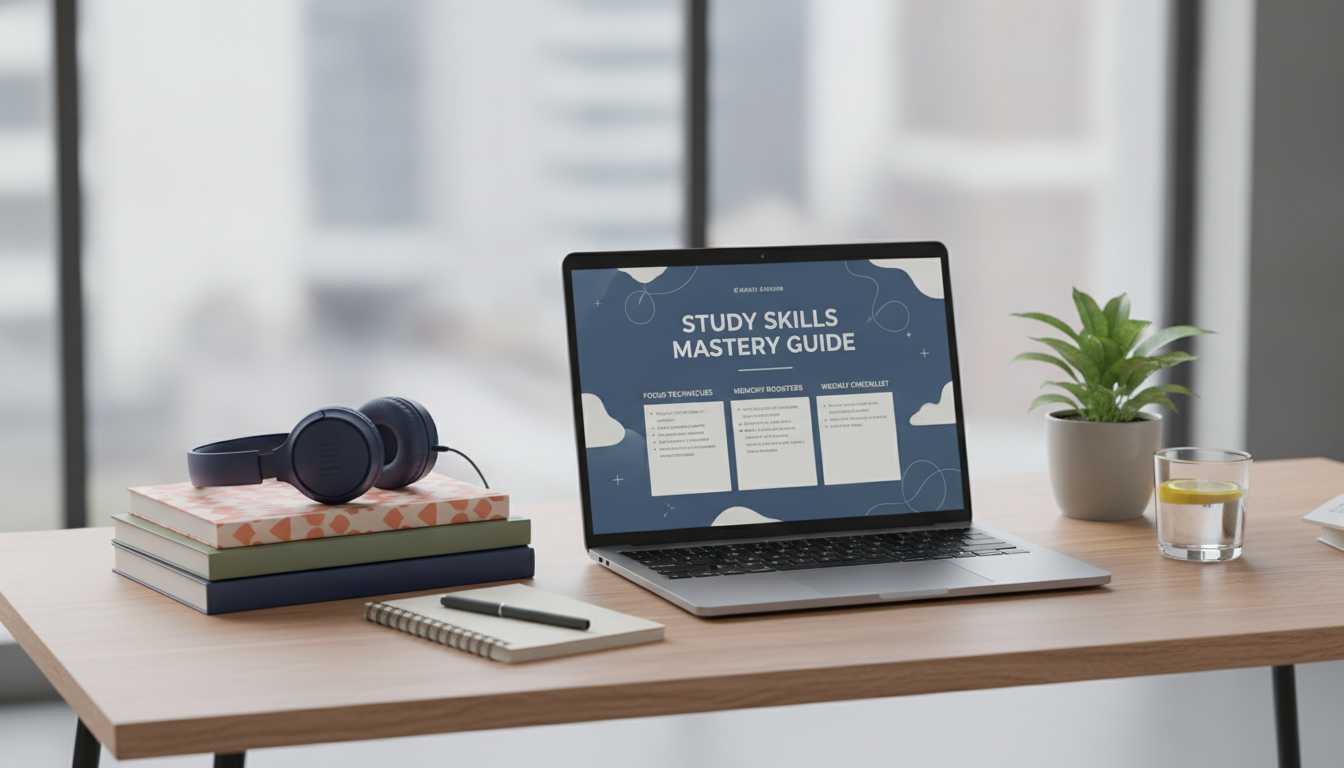
Study Skills Mastery Guide: Focus, Memory, and Study Methods That Fit Your Schedule
Better study results come from a repeatable system: clear goals, focused work blocks, active recall, spaced review, and simple tracking. When those pieces are consistent, study sessions feel lighter, procrastination loses its grip, and progress is easier to measure—even during busy weeks with multiple classes.
Start with a simple study system (not longer hours)
“Study more” is vague. A study system is specific: it defines what success looks like, how you’ll practice, and when you’ll revisit material so it actually sticks.
- Define the outcome for each subject. Set a finish line you can verify. Examples: “Solve 20 mixed problems without notes” or “Explain the concept in 2 minutes without looking.”
- Choose 1–2 primary methods per subject. Math/science usually benefits most from problem practice and corrections. Reading-heavy courses often respond best to retrieval practice plus brief summaries.
- Set a weekly rhythm. Learn new material early, practice actively midweek, and review on spaced intervals so forgetting doesn’t pile up.
- Use short feedback loops. Check answers quickly, label the error type, and redo missed items after a delay. That delay is where long-term memory strengthens.
Research consistently favors practice that forces retrieval (trying to recall) over passive review like rereading. For a primer on why self-testing works, see the American Psychological Association’s overview of the testing effect: https://www.apa.org/ed/precollege/psychology-teacher-network/introductory-psychology/testing-effect.
Focus setup: make starting easier than procrastinating
Focus is less about willpower and more about friction. Make “begin” the easiest option in the room.
- Create a 2-minute start routine. Clear desk, open materials, write today’s single target, start a timer.
- Reduce distractions by design. Put your phone out of reach, turn off notifications, and follow a one-tab rule while studying.
- Use timed work blocks (25–50 minutes). Take planned breaks (5–10 minutes). Stop at a natural checkpoint so restarting is easier.
- If attention drifts, switch to an active task. Do practice questions, self-quizzing, or teach the concept aloud for two minutes.
- End with a “next step” note. Write one sentence like “Next: redo #7–#12 and review error log.” It removes friction for your next block.
For long study days, keeping devices charged can prevent “battery panic” from derailing your work blocks; the 200000mAh 120W Power Bank for iPhone and Apple Devices is a practical option for extended library sessions and travel days.
Learning strategies that stick: active recall and spaced repetition
If time is limited, prioritize techniques with the best payoff per minute: retrieval practice and spaced repetition. A widely cited review of effective learning techniques highlights practice testing and distributed (spaced) practice as top performers: https://journals.sagepub.com/doi/10.1177/1529100612453266.
- Replace rereading with retrieval. Close notes and write what you remember on a blank page, then check and correct.
- Use low-stakes self-tests. Flashcards, practice quizzes, blank-page retrieval, and past papers all count.
- Schedule spaced reviews. A simple cadence: after 1 day, 3 days, 7 days, then weekly. Increase frequency for harder topics.
- Interleave related topics. Mix problem types or themes. It feels harder, but it builds flexible understanding for tests.
- Keep review short. Ten to twenty minutes of retrieval often beats an hour of passive reading.
Memory techniques for faster recall during tests
Memory improves when information is organized, connected, and rehearsed under conditions similar to test day.
- Chunking: Group details into meaningful categories (e.g., causes/effects, steps, exceptions) instead of one long list.
- Elaboration: Ask “why does this work?” and “how does it connect?” The goal is to create more retrieval paths.
- Dual coding: Pair words with a simple diagram, timeline, flowchart, or concept map.
- Mnemonics: Use acronyms, method of loci, or vivid imagery for sequences and definitions.
- Error log: Track mistakes by category (concept gap, careless, time pressure), then rehearse the fix.
For additional memory-friendly habits (sleep, exercise, and attention supports), Harvard Health summarizes practical approaches here: https://www.health.harvard.edu/mind-and-mood/7-tips-to-sharpen-your-memory.
Notes and materials: turn information into usable study cues
If you want a repeatable, ready-to-use structure, the Study Skills Mastery Guide (digital study guide + checklist PDF) provides a streamlined workflow you can apply across classes without rebuilding your process each week.
A weekly study checklist and sample plan
Weekly Study Checklist (printable-style)
| Task | When | Done |
|---|---|---|
| Set weekly goals for each course (1–3 outcomes) | Sun/Mon (10 min) | ⬜ |
| Schedule 3–5 focused study blocks | Sun/Mon (15 min) | ⬜ |
| Active recall session (new material) | Within 24 hours | ⬜ |
| Spaced review #1 | Day 3 | ⬜ |
| Spaced review #2 | Day 7 | ⬜ |
| Practice set / past-paper questions | Midweek | ⬜ |
| Update error log and redo missed items | After practice | ⬜ |
| Pack materials and prepare next-step note | End of last session | ⬜ |
Use a ready-made digital guide to stay consistent
The Study Skills Mastery Guide | Digital Study Guide, Learning Strategies eBook, Focus Tips, Study Methods, Memory Techniques, Study Checklist PDF is designed for exactly that: a simple system you can run on repeat.
Compare related options such as Premium Leather Magnetic Case for Apple iPhone to match features, dimensions, and use case before choosing.
FAQ
How many hours should a study session be to stay focused?
Use 25–50 minute work blocks with 5–10 minute breaks, adjusting based on task difficulty. Prioritize active recall and practice over stretching the clock.
What’s the fastest way to memorize information for an exam?
Combine retrieval practice with spaced repetition so you recall information repeatedly across multiple days. Add mnemonics for sequences and dual coding (simple diagrams) for concepts, and avoid relying on last-minute cramming as the main plan.
How can a checklist improve study results?
A checklist prevents missed steps like spaced review and error-log fixes, and it makes progress visible even on busy weeks. It also helps keep your routine consistent across subjects.
















Leave a comment