Foldable Freestanding Dog Gate: 3-Panel Barrier Guide
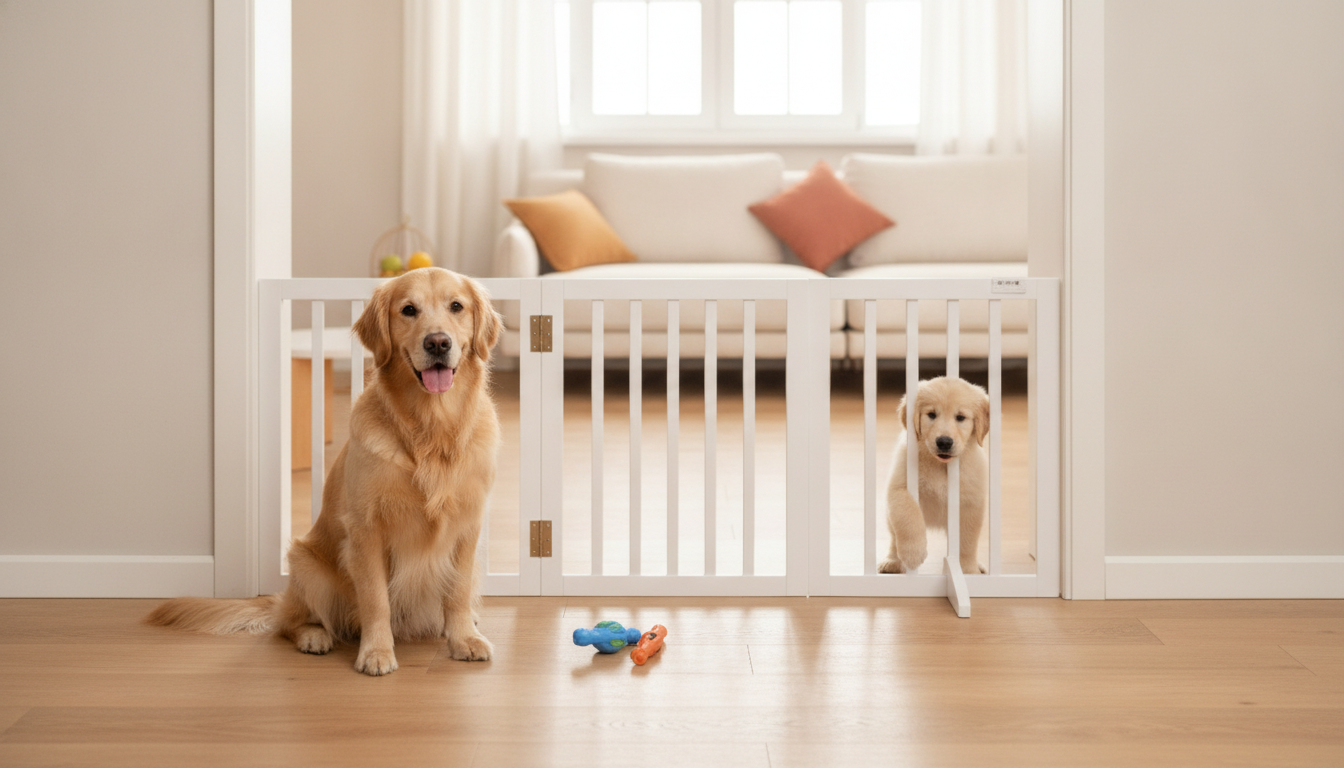
Freestanding Dog Gate: A Foldable 3-Panel Pet Barrier for Doorways & Stairs
A freestanding, foldable pet barrier helps set clear boundaries without drilling into walls. This style of gate is useful for blocking doorways, creating a buffer at the top or bottom of stairs, and guiding pets away from off-limits rooms—while still being easy to move, store, and reconfigure as needs change.
What a freestanding foldable gate does well
Freestanding panel gates shine when daily life changes quickly—food delivery at the door, a vacuum session, guests coming over, or a puppy who’s still learning house rules. Instead of committing to a permanent installation, you can place the barrier where it’s needed, then fold it away when the space needs to open up again.
- Creates a quick boundary in doorways, hallways, and open-plan spaces without mounting hardware
- Folds into multiple panels to shape around corners or wider openings
- Moves room-to-room for flexible daily use (mealtimes, cleaning, guests, deliveries)
- Works as a visual and physical cue for training boundaries and routines
- Stores compactly when not needed
For training support and safer home routines, reputable resources like the American Kennel Club and ASPCA offer helpful guidance on home management and behavior basics.
Where it fits best: common home layouts
A 3-panel gate is especially practical in homes that have a mix of narrow doorways and wider “pass-through” areas. The ability to angle panels is what makes it feel less like a rigid fence and more like a customizable room divider.
- Standard doorways: Set panels in a gentle arc for stability and coverage.
- Stairs: Place at the base to discourage access; use extra caution at the top landing and always test stability before relying on it.
- Wide openings: Angle panels or use a zig-zag shape to increase footprint and reduce tipping.
- Open rooms: Create a temporary “zone” near a dog bed area, crate, or feeding station.
Key features to look for in a 3-panel barrier
Not all foldable gates behave the same once a curious nose (or shoulder) leans into them. A few design details can make everyday setup smoother and help the barrier hold its place better.
- Panel count and hinge range: Hinges should allow multiple shapes (straight line, angled, U-shape) for different spaces.
- Freestanding stability: A wider base footprint and secure hinge tension help resist nudging.
- Surface finish: Smooth edges and pet-safe materials reduce snagging and scratches.
- Height suitability: Choose a height that discourages jumping for the pet’s size and behavior.
- Floor compatibility: Consider hardwood, tile, and carpet; adding a non-slip mat can improve grip.
- Fold-and-carry practicality: A simple fold pattern makes daily setup less frustrating.
Quick comparison: freestanding vs pressure-mounted vs hardware-mounted
Choosing the right gate style depends on how permanent you want the setup to be, how much force your dog tends to apply, and where you’re placing the barrier.
| Type | Setup | Best for | Limitations |
|---|---|---|---|
| Freestanding foldable panels | No drilling; reposition anytime | Temporary zones, rentals, moving between rooms | May shift with strong pushing; stability depends on shape and surface |
| Pressure-mounted gate | Tension fit in doorway | Everyday doorway use for many households | Can loosen over time; stair-top use may be restricted |
| Hardware-mounted gate | Screws into wall/banister | Stairs and high-security containment | More permanent; installation required |
Using a foldable gate for stairs: safety notes
Stairs are a special case because a slip or tip can be more serious than a gate shifting in a hallway. If a gate is going near stairs, stability testing should be part of the routine—especially if your dog is fast, strong, or tends to rush boundaries.
- Always test the barrier’s stability before each use, especially on slick floors or uneven landings.
- Avoid relying on a freestanding barrier at the top of stairs for large, fast, or persistent dogs—use a dedicated stair-rated solution when needed.
- Position the barrier on a flat area with enough space to angle panels for a wider footprint.
- Keep the area clear of clutter that could create a step-up point for jumping.
For general home safety reminders and pet management tips, the Humane Society of the United States is another solid reference point.
Setup tips for better stability (without permanent installation)
Care, cleaning, and storage
When a freestanding barrier may not be enough
Product picks (in stock)
- Freestanding Dog Gate – Foldable 3-Panel Pet Barrier for Doorways & Stairs — a no-drill, move-anywhere barrier designed for quick placement in doorways and near stair areas. $48.67 USD.
- Mini Pocket DAB/DAB+ FM Radio MP3 Player with Speaker & Rechargeable Battery — a compact option to keep hands free and attention up during chores or training sessions. $42.67 USD.
- Wireless Bluetooth Backlit Number Pad for Apple Devices — a handy add-on for home offices where pets are being managed between rooms. $32.51 USD.
FAQ
Can a freestanding dog gate be used at the top of stairs?
It can be placed near stair areas, but safety depends on the dog’s behavior and the surface. Always test stability before each use, and use a stair-rated mounted gate when the situation calls for higher security—especially at the top landing.
How do you keep a freestanding pet gate from sliding on hardwood floors?
Shape the panels into a zig-zag or shallow “S” to widen the footprint, and place the ends lightly against walls or trim. Adding a non-slip mat or rug pad under the contact points can also improve grip on hardwood.
What size dog is a foldable panel gate best for?
It depends more on jumping ability and persistence than weight alone. Foldable freestanding gates are often best for small-to-medium pets or supervised use, while determined pushers or jumpers may need a taller or mounted barrier.














Leave a comment